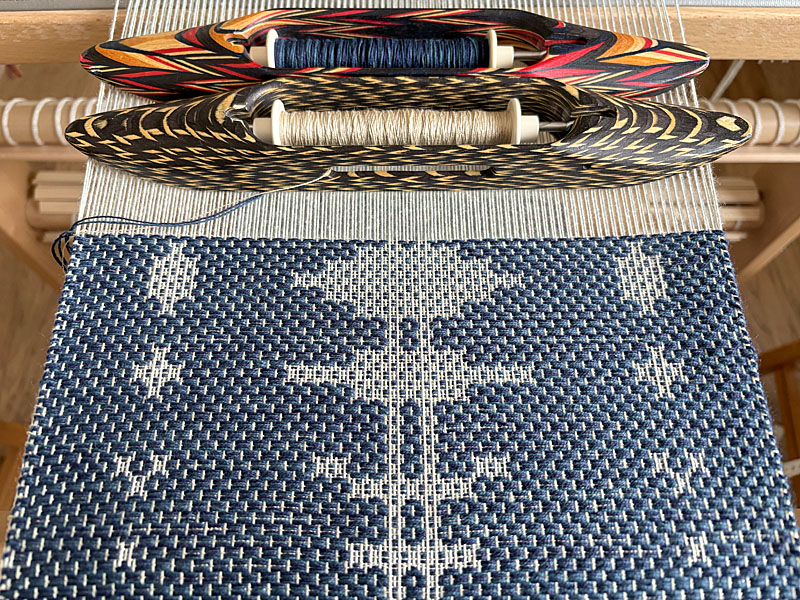
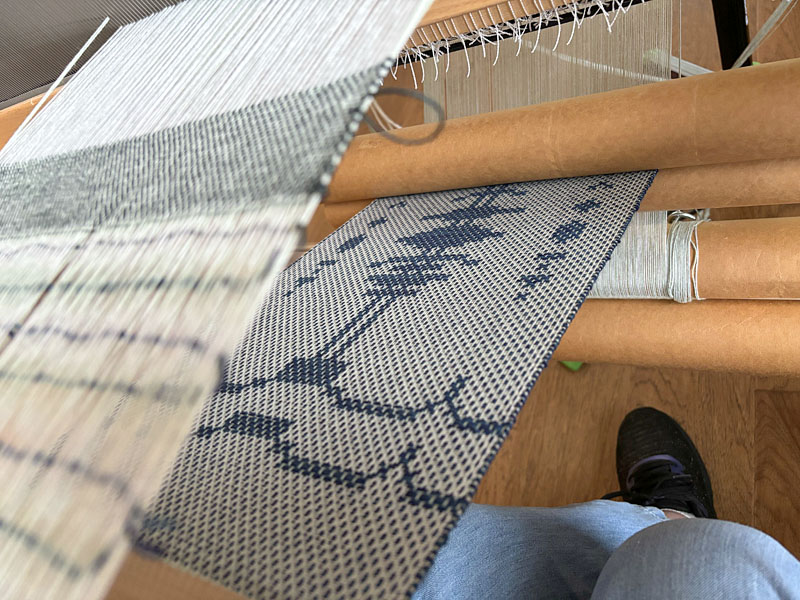
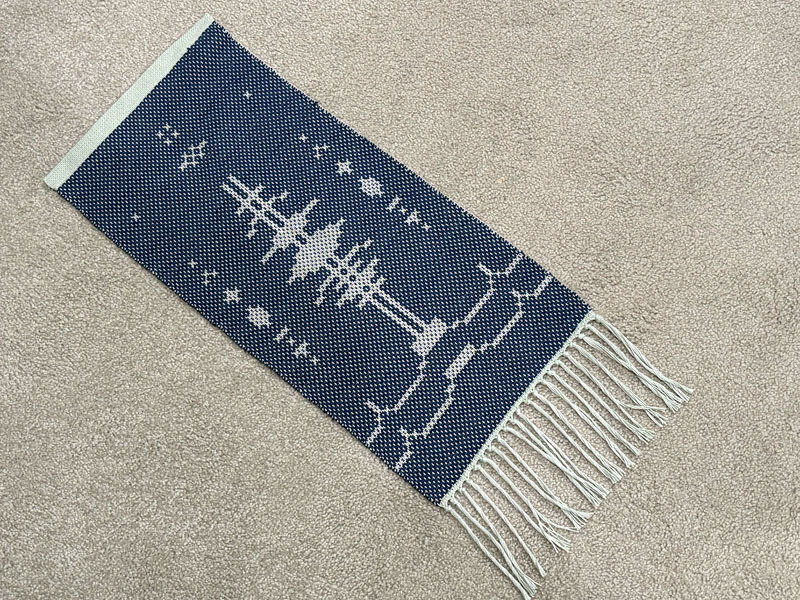
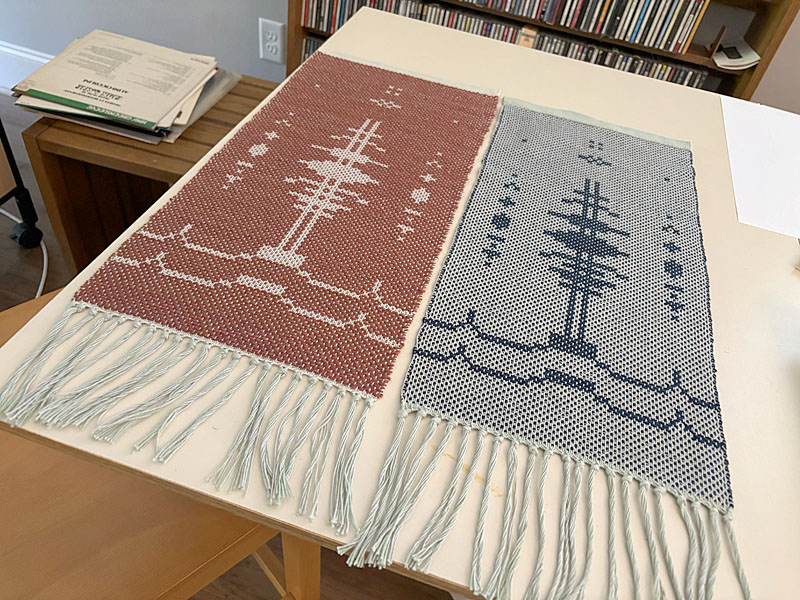
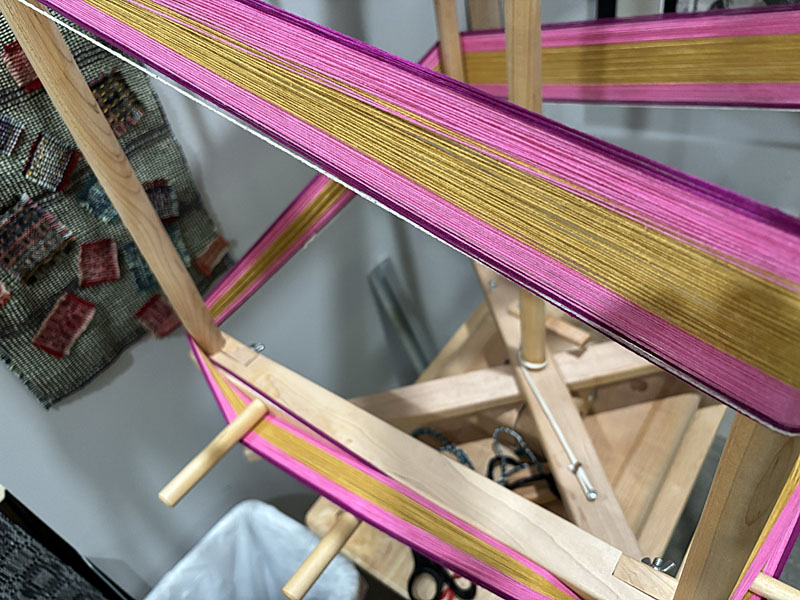
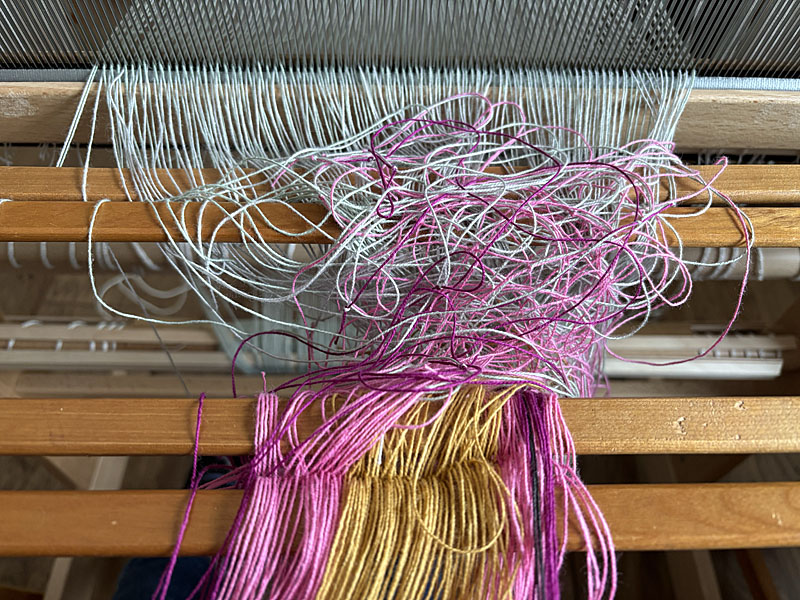
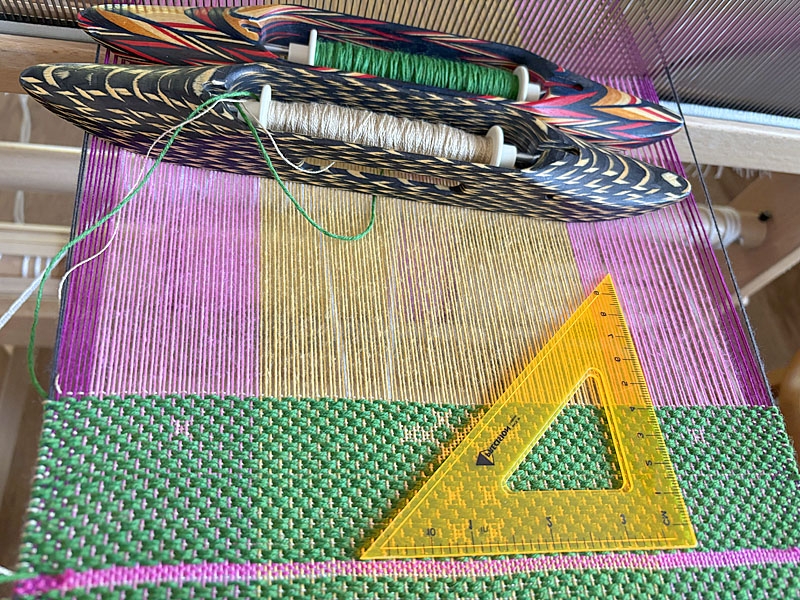
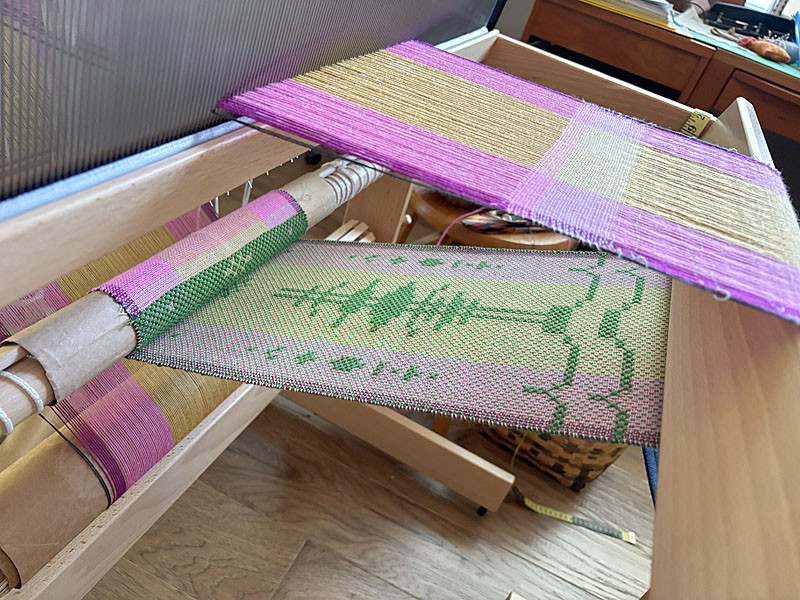
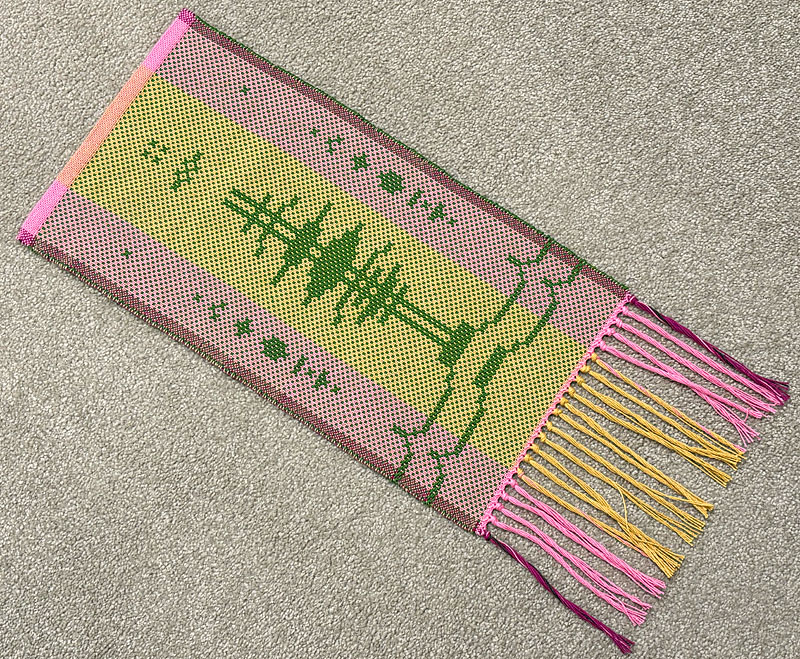
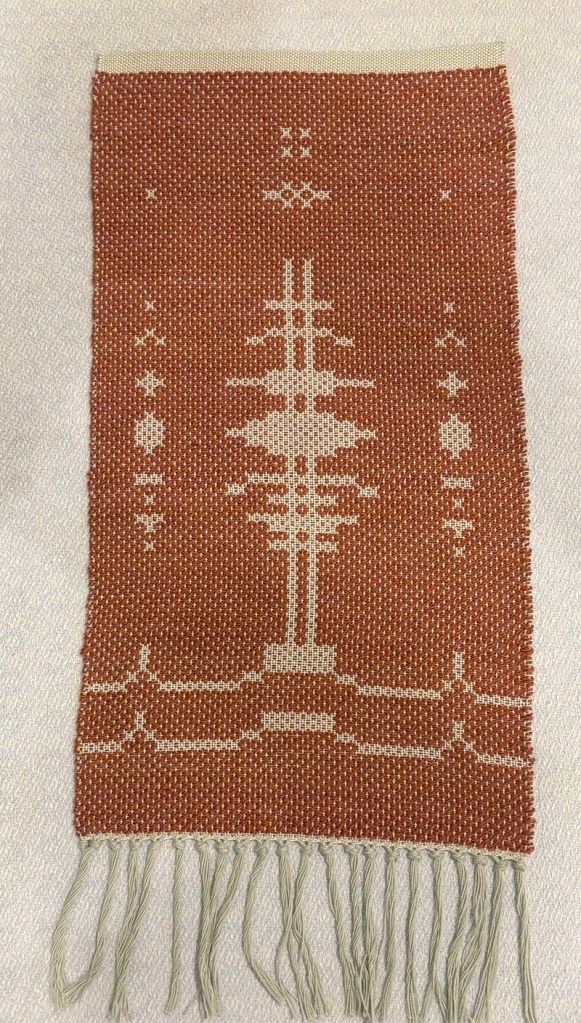
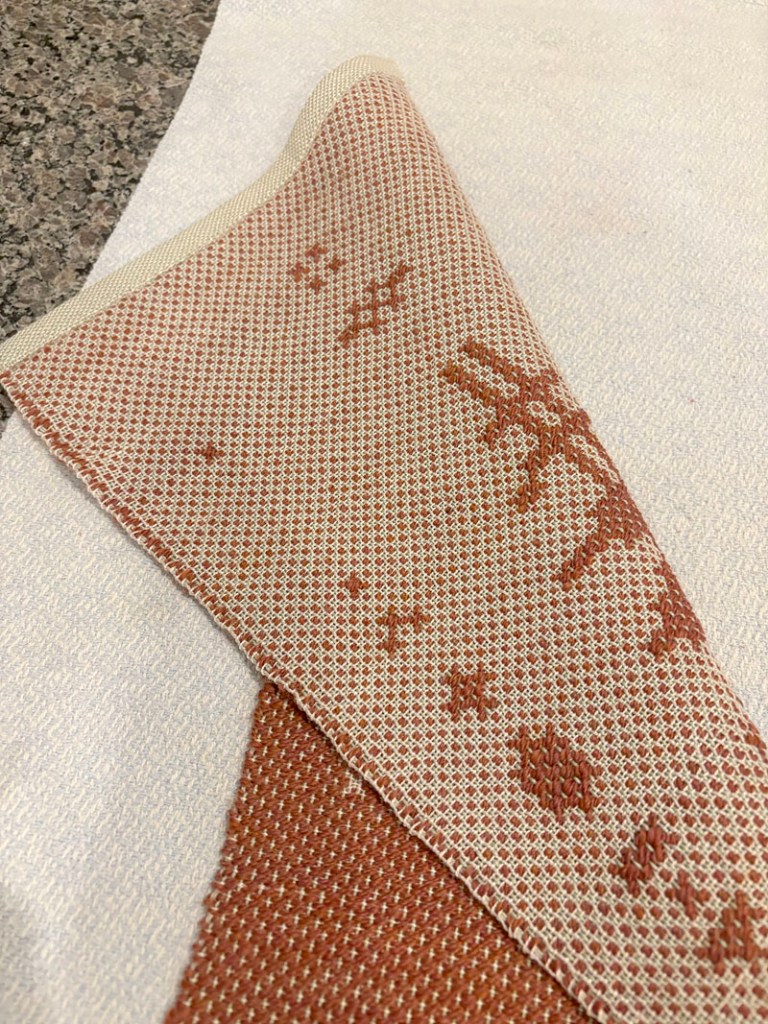
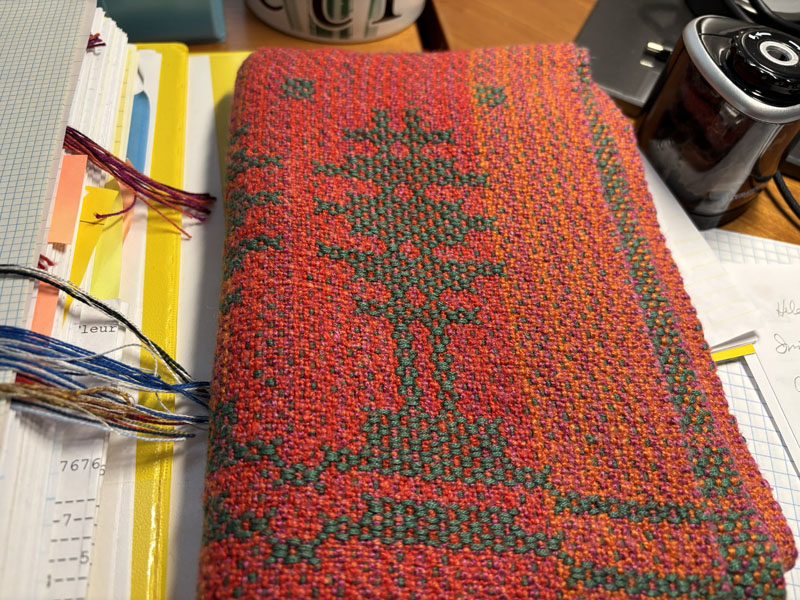
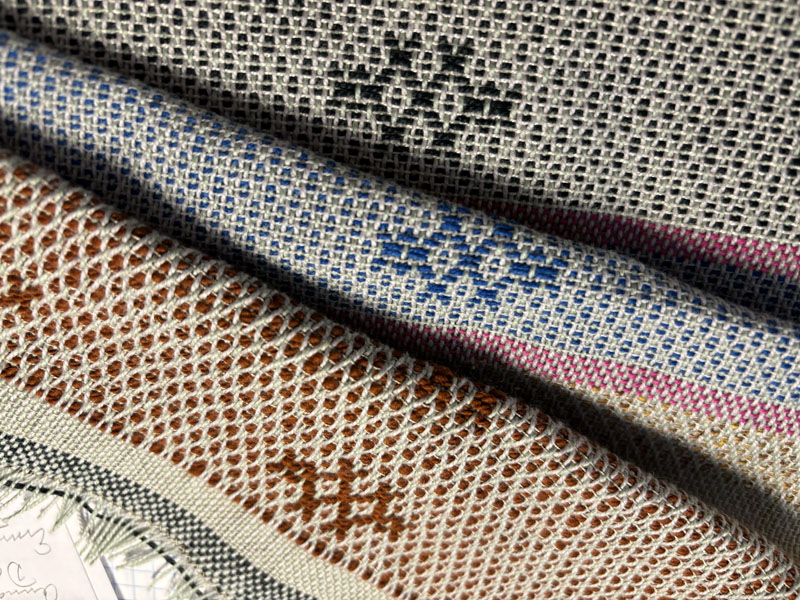
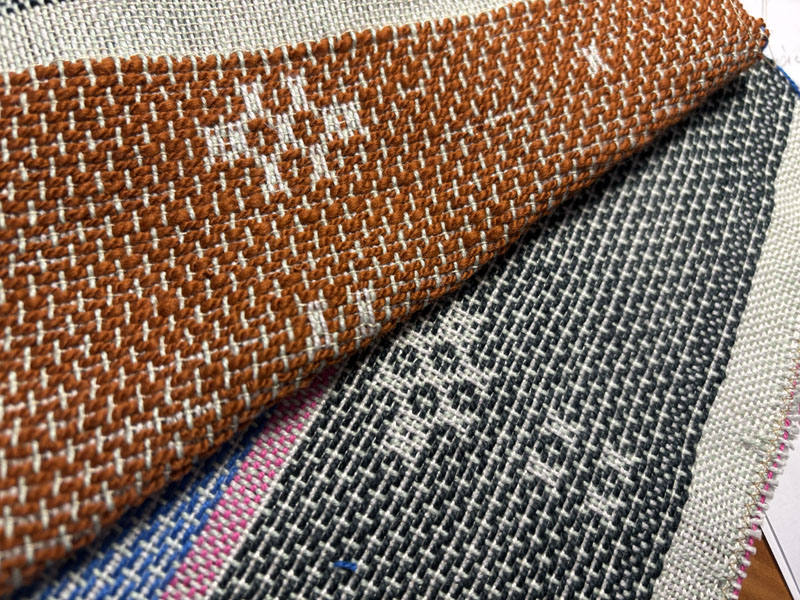
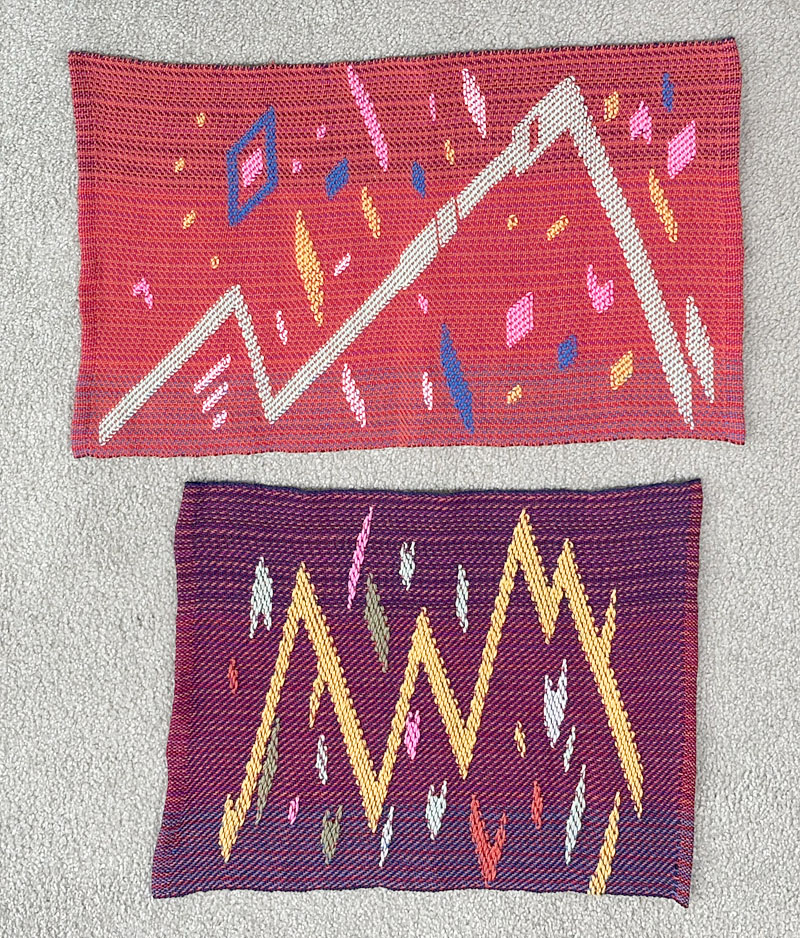
All of these are on cotton warps. The tabby wefts are all natural colored spun silk. The monochromatic brown tree features a pattern weft of brown handspun wool; the blue one has a blended blue cotton pattern weft. The multicolored warp was tied on to the monochromatic warp and was woven with green fingering-weight commercial wool as the pattern weft. There’s enough multi warp left for at least one more tree. Stay tuned.
Department of Books: I just finished reading American Hagwon by Min Jin Lee. Recommended.
Here it is off the loom, at last, hemmed at the top, bathed lightly, and drying on a towel. Just couldn’t wait to show you. Haven’t yet worked out the hanging device. Perhaps a small dowel threaded through the header.
There were so many blips in the process. Rethreading, resleying, a huge treadling error that did not appear until completion and had to be repaired. Many people ringing doorbells, that sort of thing.
But I am so pleased to see the x’s peeping through on both sides. Which side is the “right” side? Who knows? Does it matter? Let’s just let the dear thing finish drying and we’ll decide later.
Warp is 8/2 cotton, pale green & gray, pattern weft reddish brown handspun wool, and tabby 10/2 cotton, natural.. Original 7 shaft draft, based on traditional pine tree profiles, woven on an 8 shaft loom.
I love the pine tree borders on old coverlets. Here’s a pine tree runner I wove many years ago based on an old coverlet pattern, source unknown. It’s executed in summer and winter, with the treadling sequence that produces X’s.
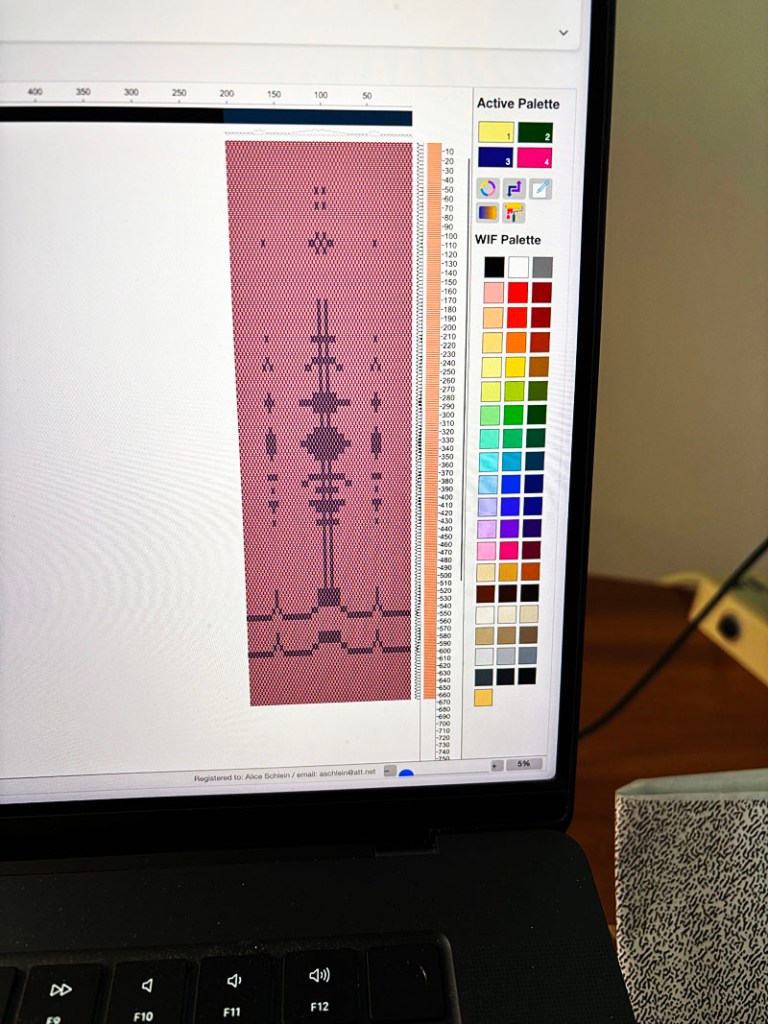
Last week I played around with new pine trees. using TempoWeave software. The block substitution feature was really helpful. I chose the treadling sequence that produces X’s.
I wove some samples and found it challenging to weave it in the proper aspect ratio.
But I think I’m on the right track now.
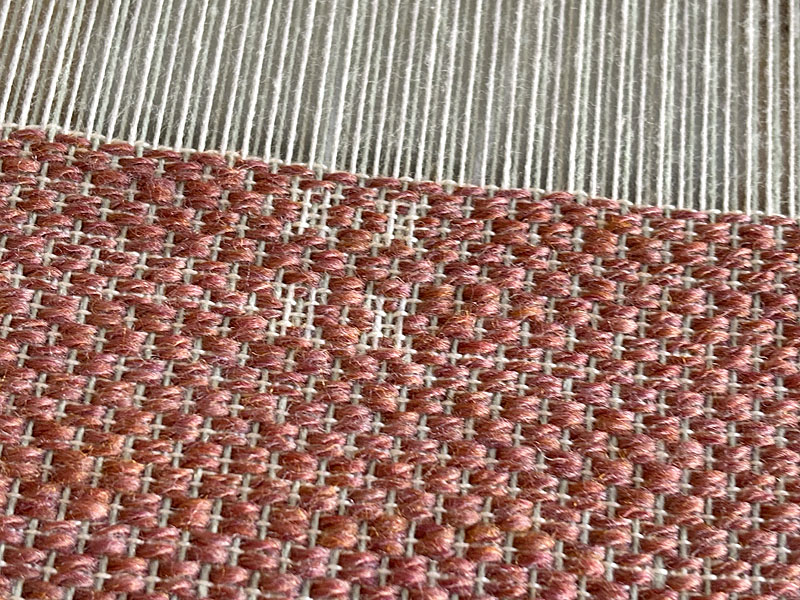
Warp 8/4 cotton, 20 epi. Pattern weft handspun wool/linen blend; tabby weft very fine silk (?) from my stash. Stay tuned.
This post has been simmering on the back of the stove, and I think it’s time to serve it up. I’ll bet you were wondering where I’ve gone?
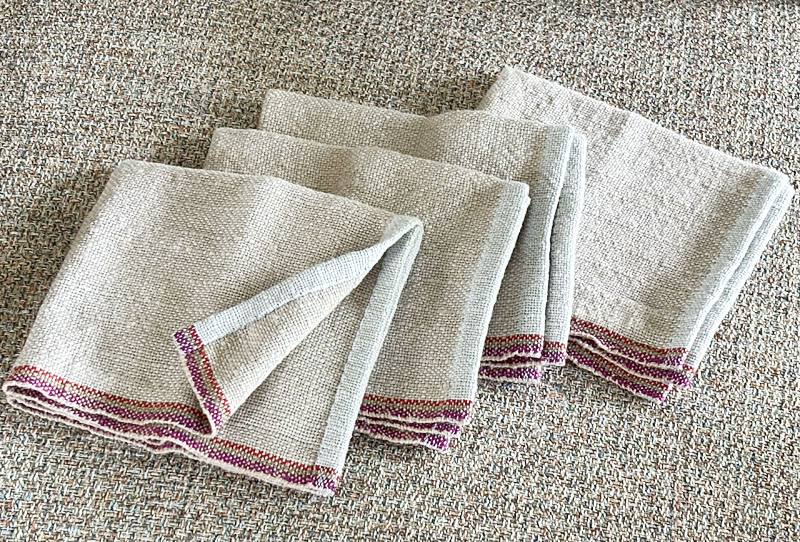
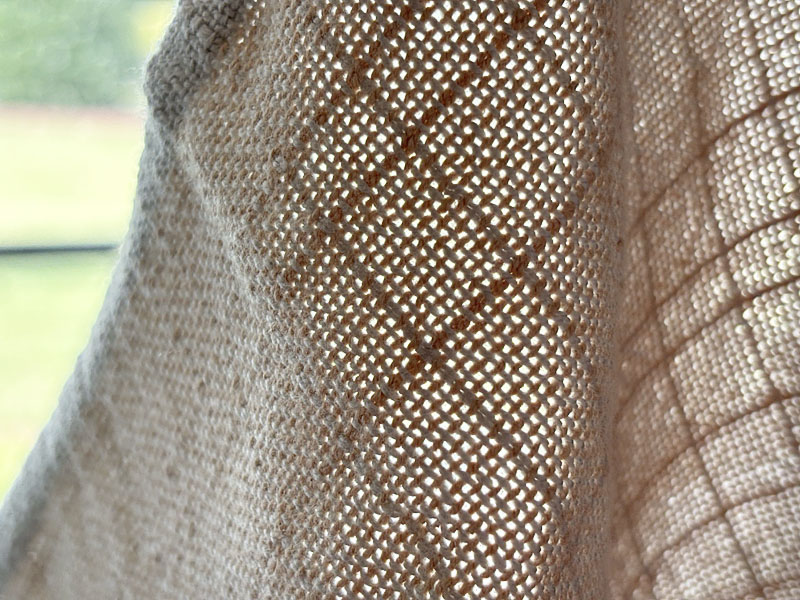
On the left is the set of napkins in English tabby. They’re servicable but not very glamorous. The real fun begins when you hold them up to the light and see the texture. The doubled ends are revealed.
Last week, in going through a box of old clippings, I found a wonderful article from the Fall 1966 issue of Handweaver & Craftsman magazine, entitled SUMMER-AND-WINTER; Experiments With Four Blocks on Four Harnesses, by Mae Aldrich. The author, by the way, was founder of the New England Weavers’ Seminar.
In her article, Aldrich presents an unusual version of S&W in which the traditional 2 blocks, with tie-downs on shafts 1 and 2, are augmented by another two blocks with tie-downs on shafts 3 and 4. Block A is threaded the usual 1323, and block B 1424. Shafts 1 and 2 are the tie-downs. But when you add two more blocks, the tie-downs for the added blocks are on shafts 3&4, and block C becomes 4232, and D 4131. The trick here is that when going from Blocks A&B to C&D, or vice versa, a transition thread must be added (Incidentally, Donna Sullivan, in her book Summer & Winter: A Weave for All Seasons has some excellent information on this S&W variation. Used copies of her book are readily available on the Internet).
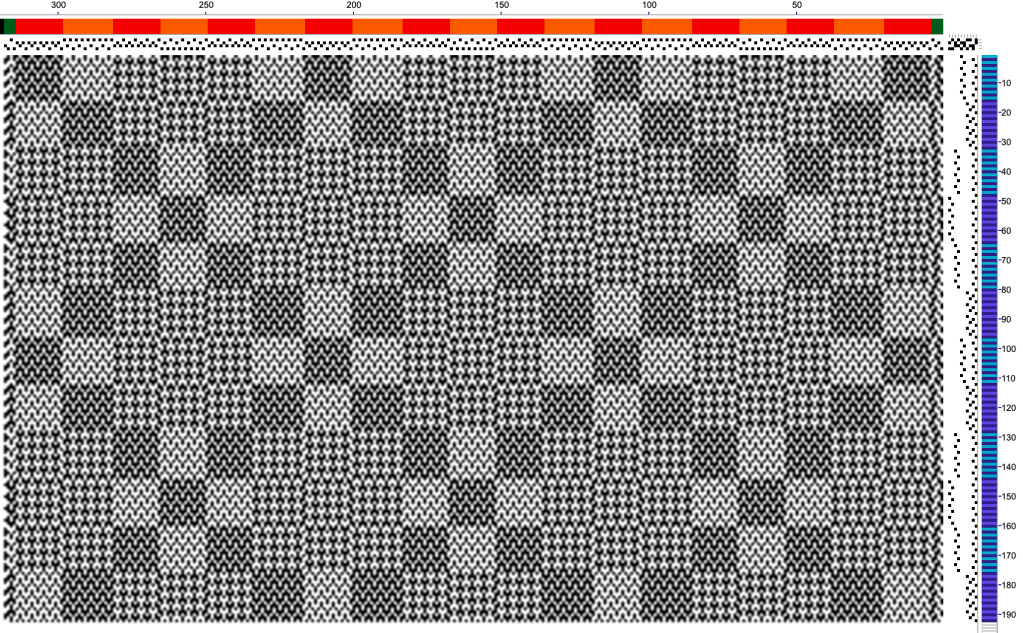
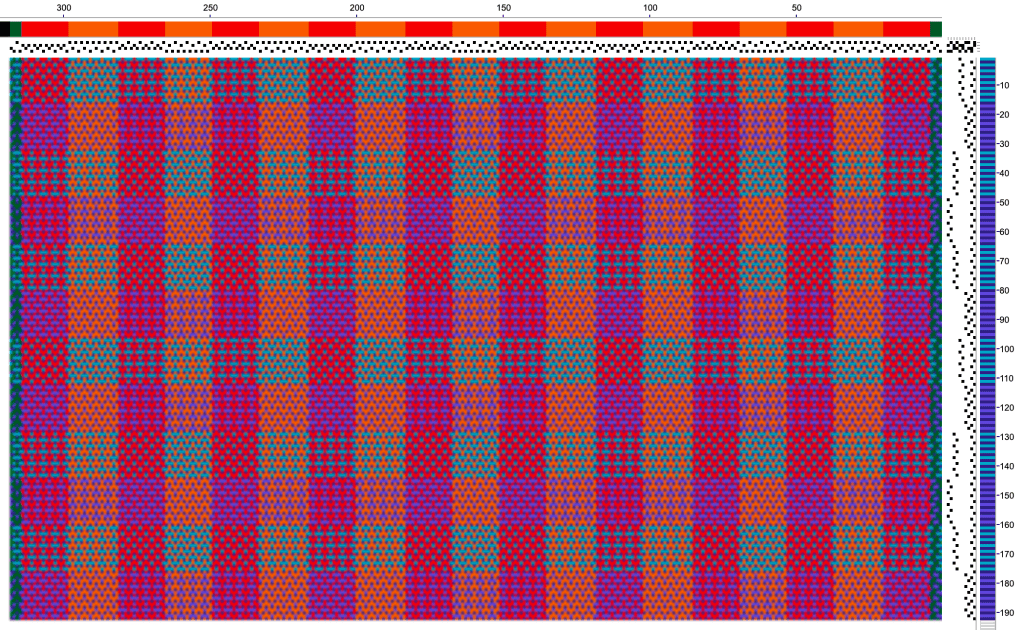
Now if the idea of 4 blocks on 4 shafts wasn’t strange enough, the addition of color to the mix really surprised me. On the left is one of my sample drafts shown with a structure-only drawdown (think black warp and white weft), and on the right is the exact same draft with color added to warp and weft! The underlying block pattern disappears and in its place is a virtual carpet of texture effects.
Here’s a close-up. Some day I’ll weave this. Meanwhile, if you’re curious about the draft, I’ve uploaded a similar version to handweaving.net as draft #81645. Enjoy.
I should mention that yesterday I took the morning off to watch the Formula 1 race from Monza, Italy, and was transfixed by the spectacle, but I also gleaned a bit of wisdom from the commentators as the cars were circling the track at 200+ mph. Here it is: “Catching up is easy, overtaking is hard”. I feel there’s some advice in there for us weavers, I just haven’t figured it out yet.
I’ve come to the end of the sample warp woven from #33462 on handwaving.net and it has now been cut off and washed.
Here’s a look at the original draft:
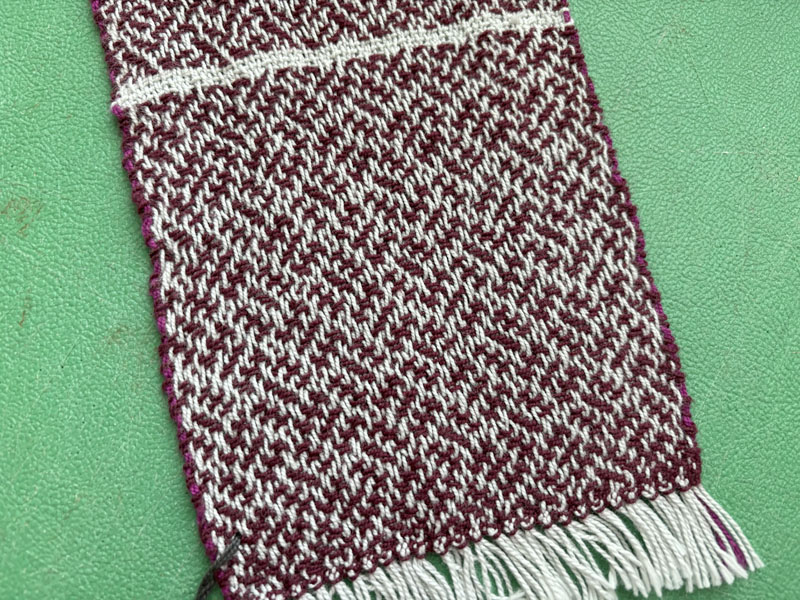
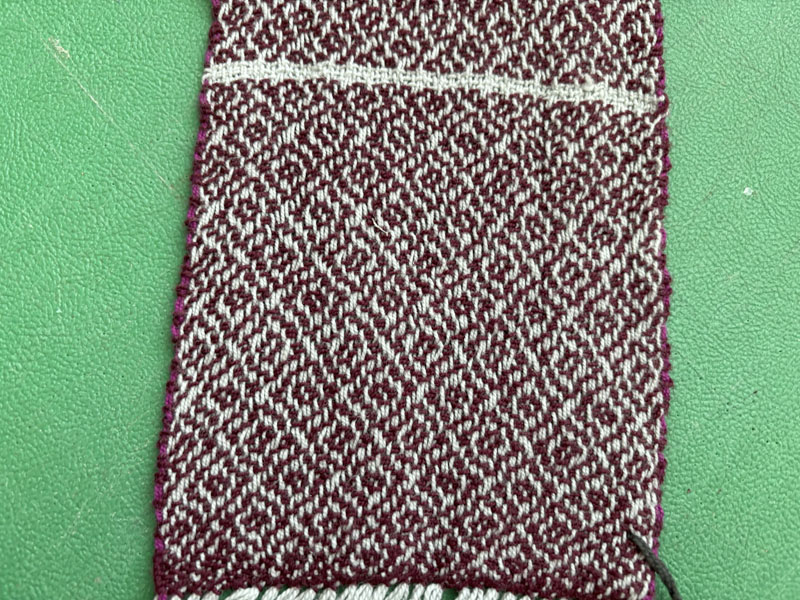
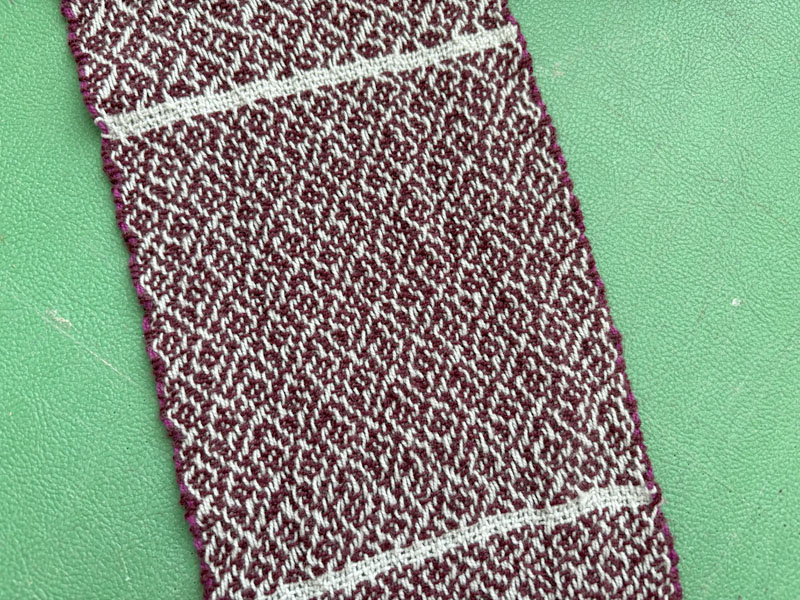
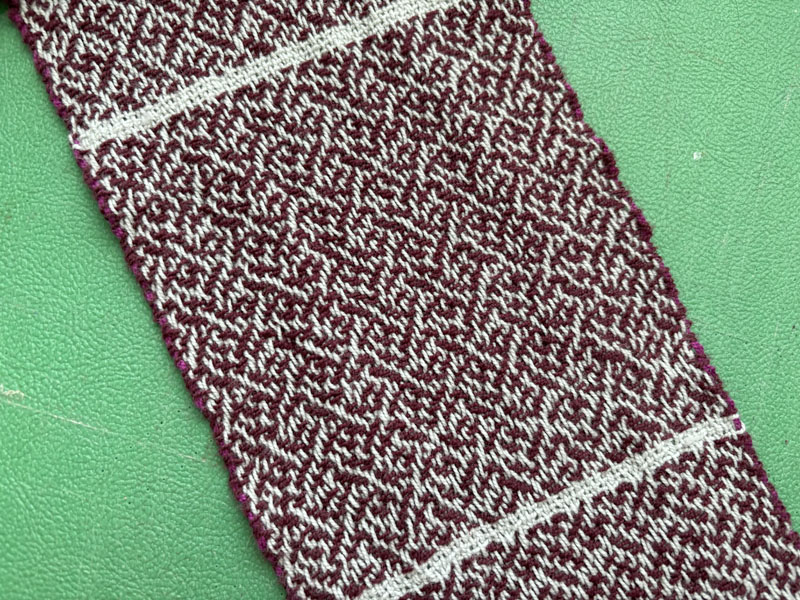
The washed & dried samples: below are the original draft 33462 (L) and its reverse (R)…
…and on the left below with its tie-up wrapped 1 position to the right, and its reverse…
…and wrapped again and its reverse…
…and wrapped again and its reverse.
Now maybe these samples look less than thrilling to a color enthusiast, but if you’re a structure nerd like me, you may enjoy them. I find these subtle differences that come from the wrapping/shifting of a tie-up endlessly interesting. I’m looking forward to weaving one of them soon as a bath towel, again with contrasting warp & weft, and perhaps with flashy selvedge treatments.
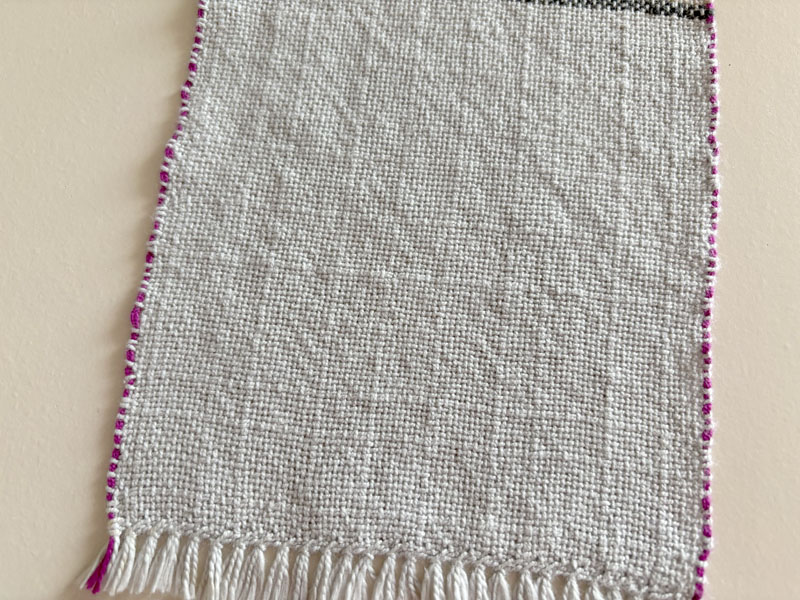
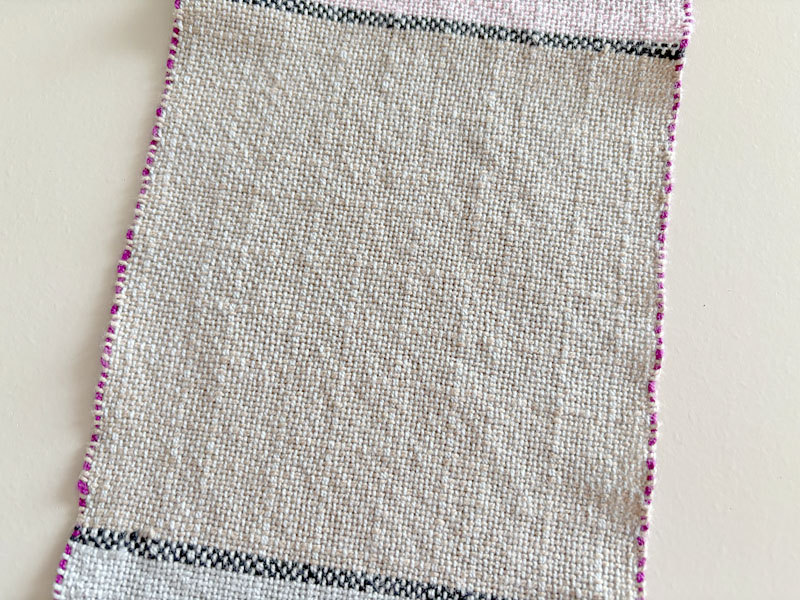
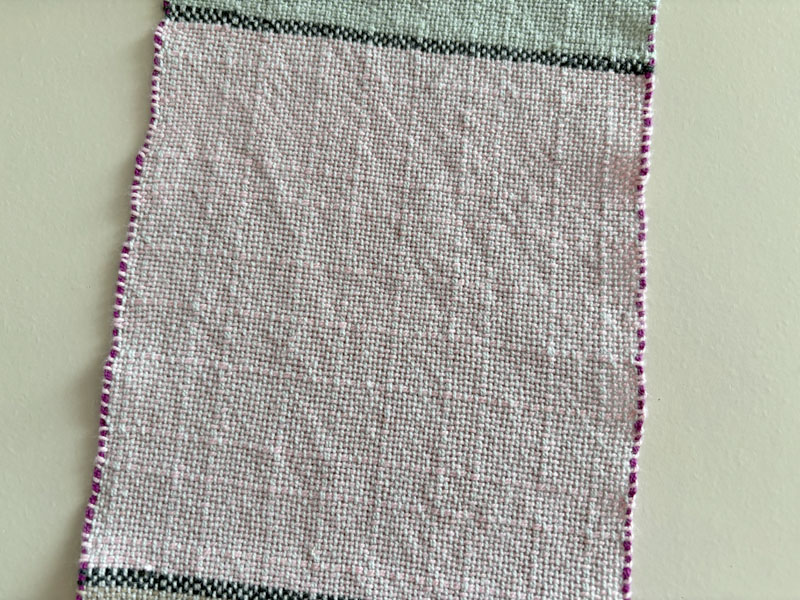
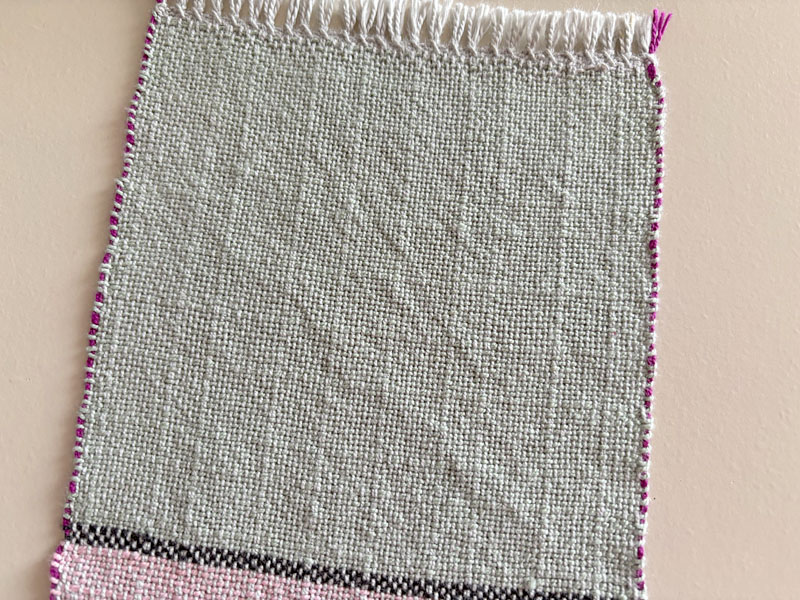
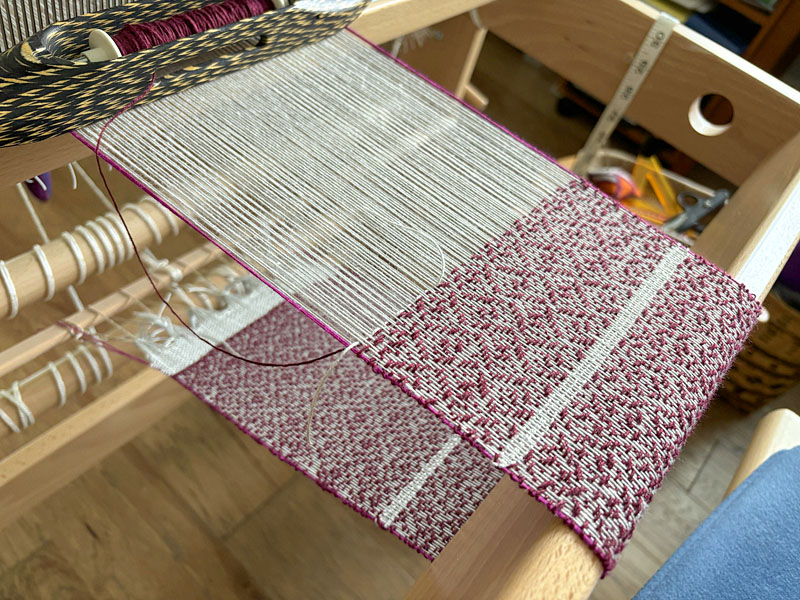
I tried weaving some English Tabby (see drafts in my previous post) on a 6″ wide sample warp and weft of 8/2 cotton, in pale gray. Then I repeated the exercise three more times, with beige , pink, and then pale green wefts, just to see if I had any favorites. I wanted a minimum value contrast between warp and weft, and my goodness, that’s what I got! In the photos, there’s not much to choose among the four samples, post washing. I can’t say it was time wasted, because I love sample weaving, and it was kind of fun to get into the rhythm of throwing double wefts from time to time.
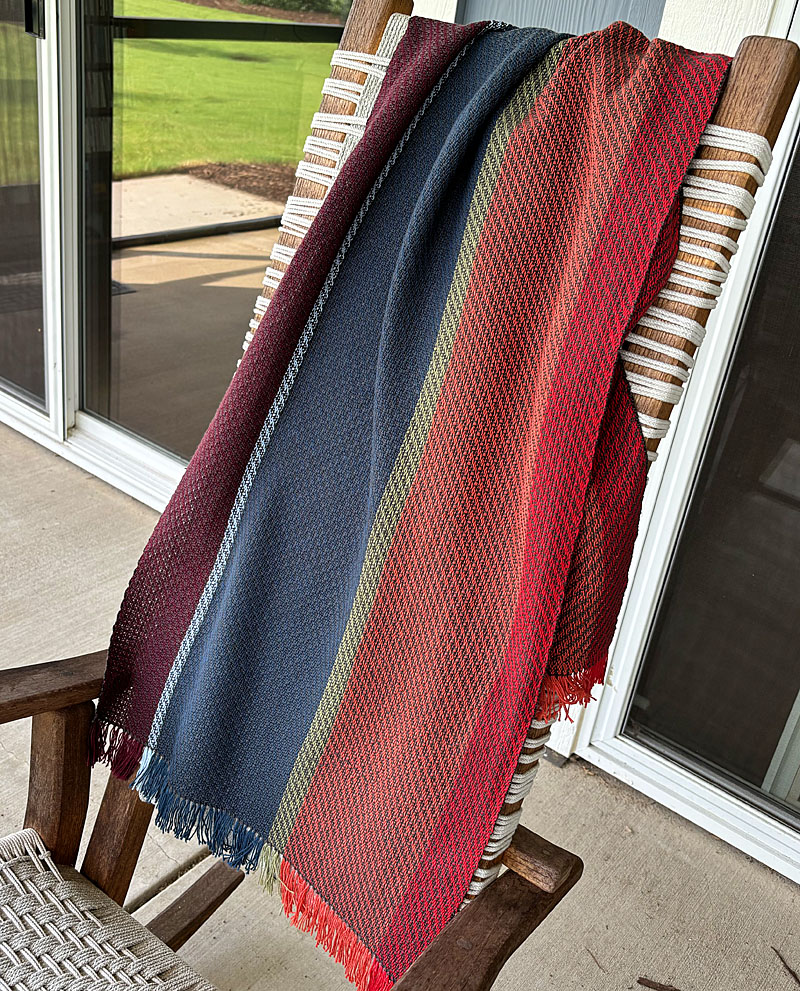
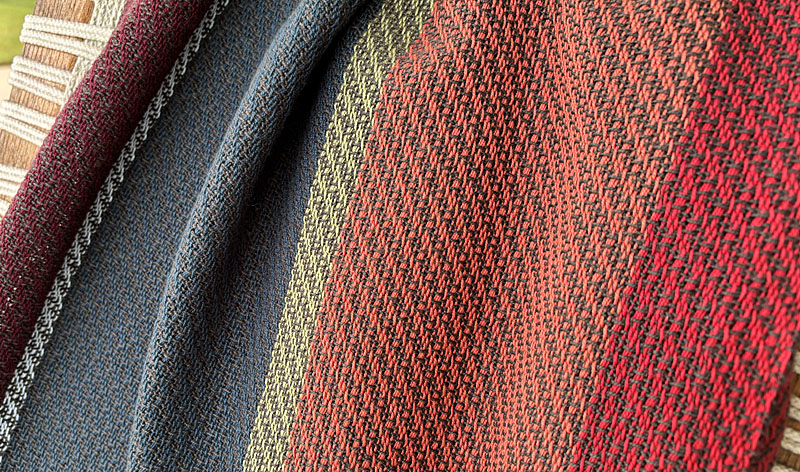
After all that, I think I will go with the monochromatic gray/gray version, and look for drama in some fancy selvedge stripes in multicolor. I think the texture of the English Tabby structure is very appealing in its homespun look, and I will enjoy adding a few new napkins in this structure to my personal collection.
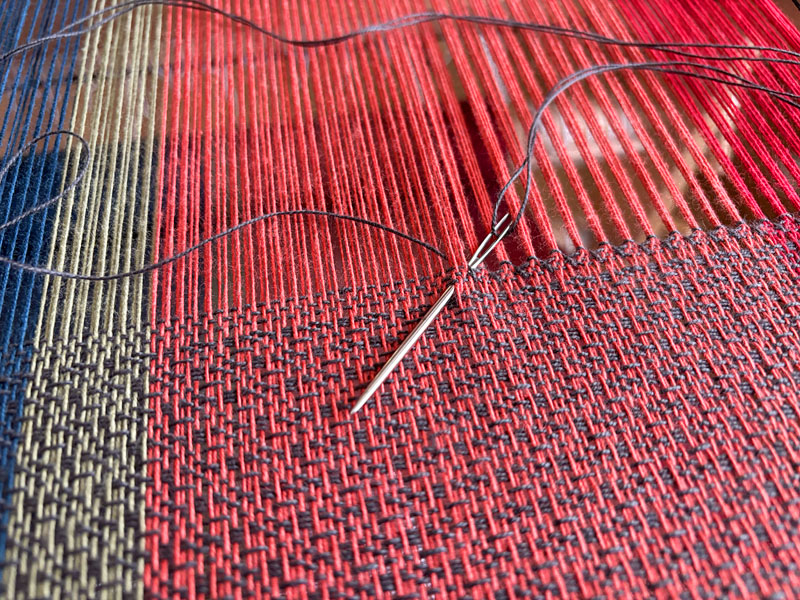
Meanwhile, there was enough of the gray warp left to weave some more samples. I had left the lease sticks in––the E.T. structure does not allow a true tabby––and I rethreaded to a draft I found on handwaving.net If you’re curious, it’s draft #33462. The fun and games here is to see what happens when the tieup is wrapped or shifted. In this case I wove the first sample as drafted, then each subsequent version will be shifted one position to the right. In the following photo I am working on the third sample, and one more to go. There will be just enough warp left. And then into the washing machine.
Department of Books: I have just finished reading Soundings Edge; Nicholas Cruwys Naval Series Book One, by Adrian Westbrooke. If you’re into Naval Fiction (which I am) you might enjoy it, otherwise skip this one. Not nearly as good as the Patrick O’Brian Aubrey/Maturin series, which I love.
And for a change of scene, here’s the lovely full moon of a few evenings ago, from my front door. Take a deep breath.
First, a disclaimer. I am not a cat person. Never had a cat, probably never will.
A few weeks ago I came upon a structure named English Tabby. It is certainly plain weave, with a twist.
And it can be woven on as few as 2 shafts.
The idea seems to be to add texture to plain weave, as if heavier threads were added randomly. Why this is understood as being distinctively English, I have no idea.
When I tried to search for a little clarification about this weave structure, I found myself in a rabbit hole of cat references (to mix a few metaphors). Apparently the Internet is determined to tell me that all references to tabby are about cats. But going a little further, I found that the distinctive coat pattern on tabby cats is from a plain weave silk fabric with an irregular wavy finish. So the fabric defines the markings on the cats. We are in a loop.
Be that as it may, I’ve got the urge to weave a little bit of English Tabby. A small sample. I can’t imagine that such a threading would be useful as a basis for weaving other structures. But you never know. Interesting structures arise from unexpected places. Meow.
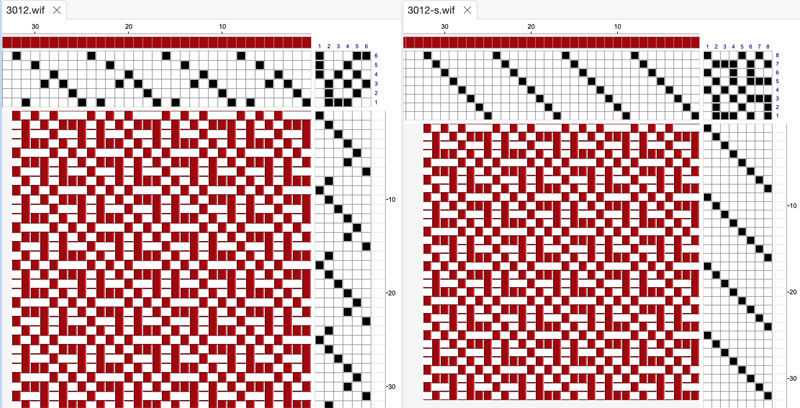
There was a little bit of warp left on the loom after my brocade samples were finished. It was threaded in a straight draw on 8 shafts, and I was looking around for something new to try and came across this oddity on Handweaving.net: it was presented as weavable on 6 shafts but I really wanted to weave it on my existing straight threading on 8 shafts. Fortunately Handweaving.net has a nice feature to instantly convert it (View: Straight threading, View: Straight treadling). In the image below, the original draft #3012, as submitted by Ralph Griswold, is shown on the left and the converted version for 8 shafts on the right.
Note: you can also do this conversion/simplification in TempoWeave. Go to Tools>Simplify Draft.
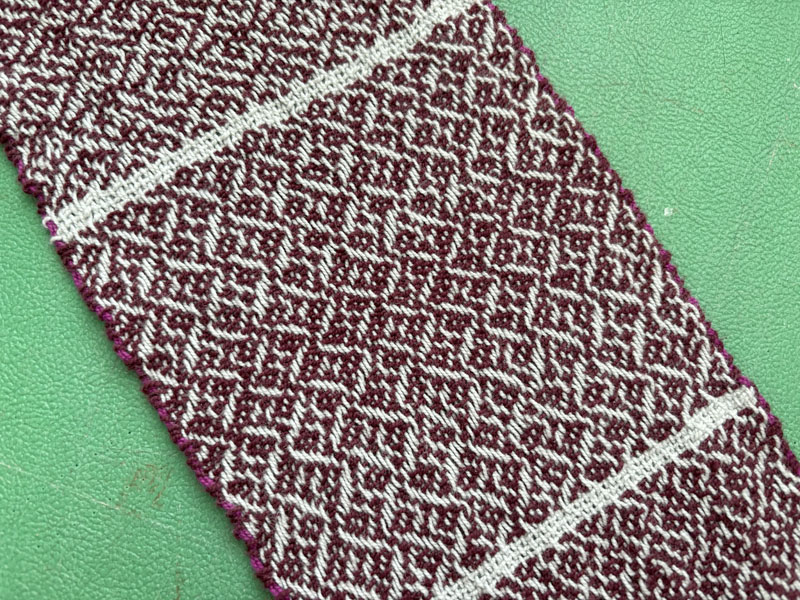
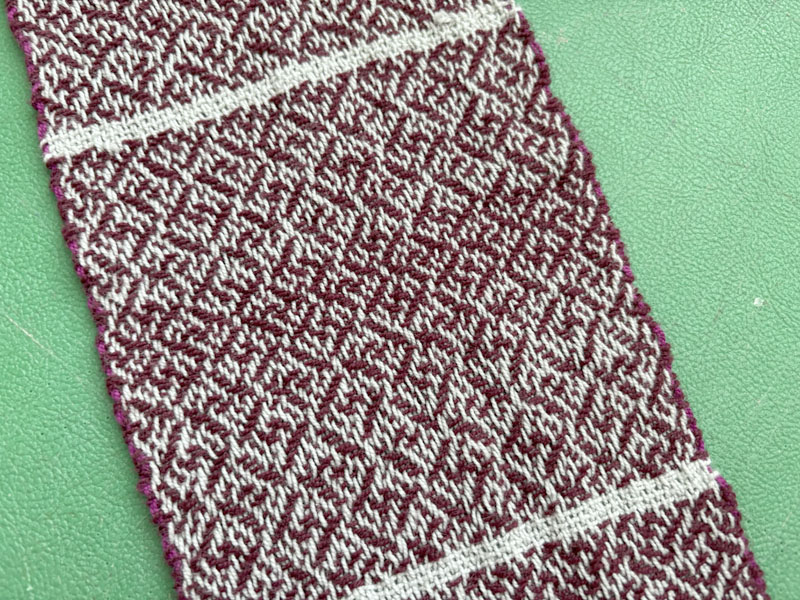
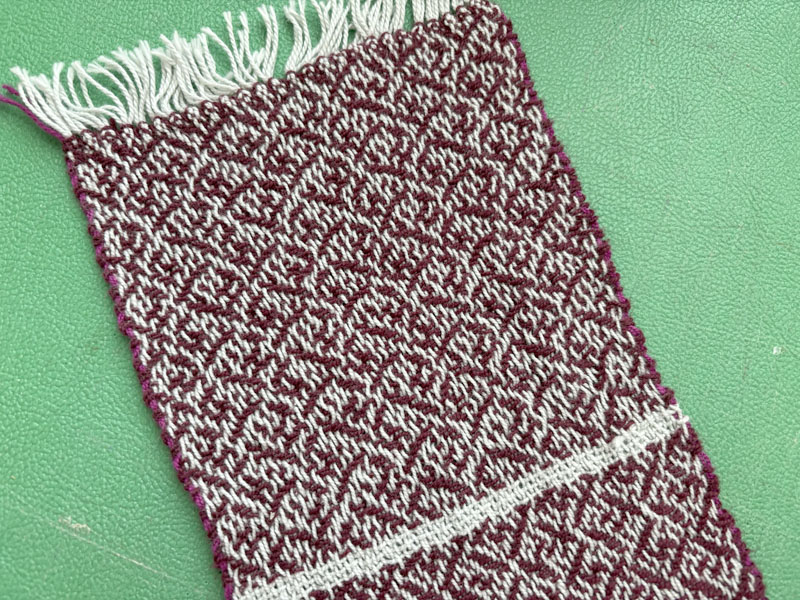
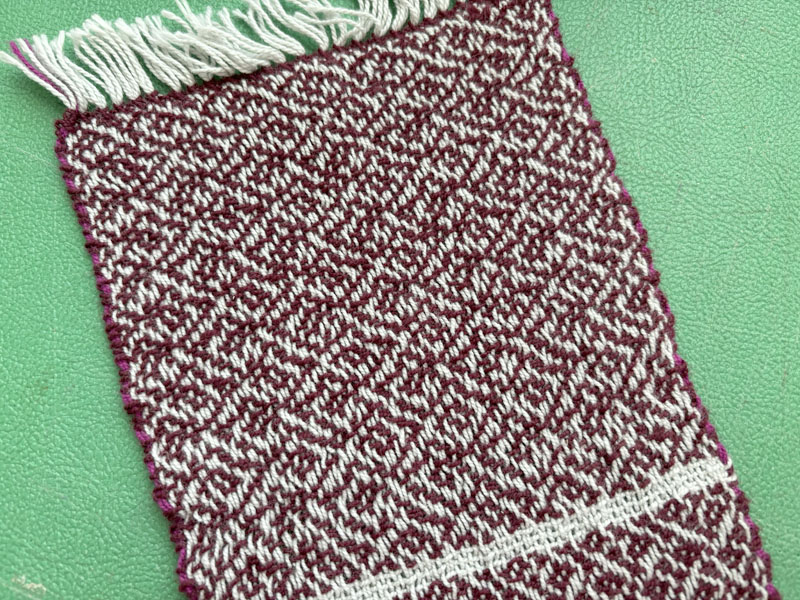
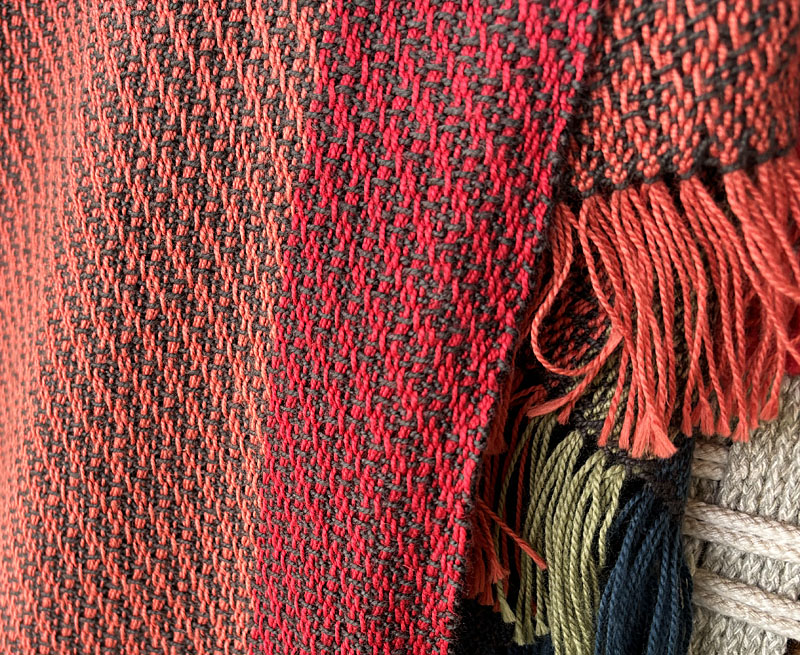
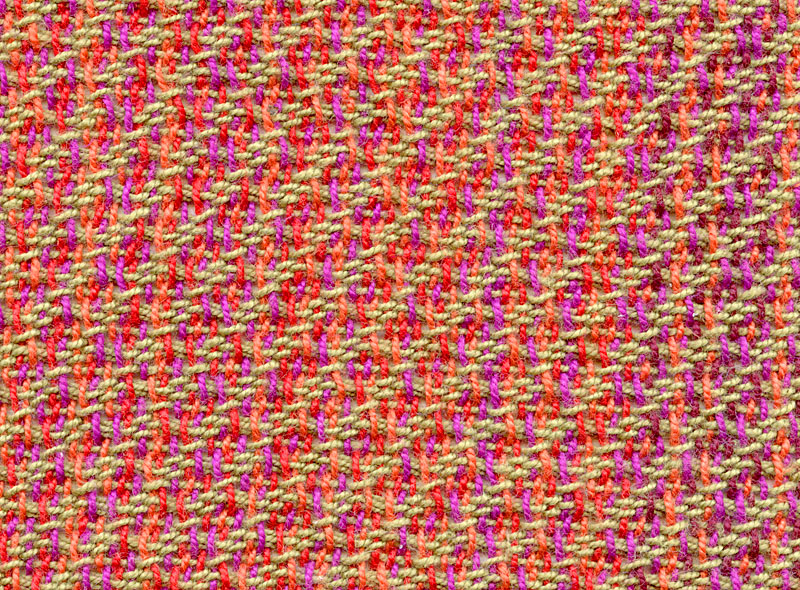
Here is the woven sample after washing. I don’t know what you’d call the structure. It has a lacy appearance with a maximum float length of 3 in warp & weft. The face and reverse are slightly different. Is it a crepe? a lace weave? a twill variation?
And the reverse side: 8/2 cotton @ 16 epi and p p i.
Department of Books: I’ve just finished reading The Custom of the Country by Edith Wharton. Loved it. The most despicable protagonist ever!
The final challenge for this series was to weave a parallelogram within another parallelogram. This little critter kept me entertained for a whole day.
Both samples on the current warp have now been cut off, washed, and hemmed. I flung them on the floor for a quick snapshot. Prettier pictures to follow, I hope.
I don’t know which way they will ultimately be displayed. Not necessarily the way they were woven. Four choices!
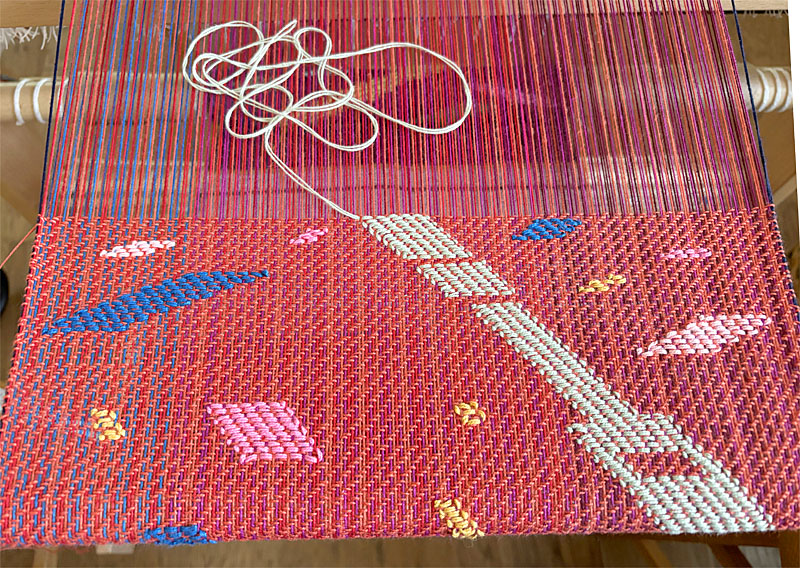
On the loom. A few picks per day. It now looks like an invasion in the studio.
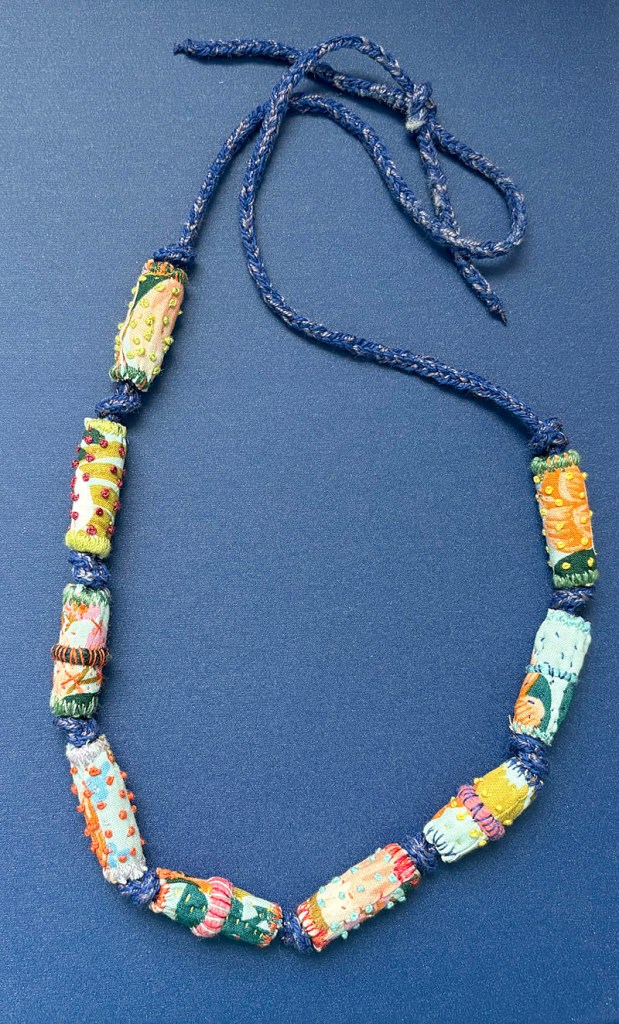
Following: fabric beads from the previous post strung on a lucet-made cord, with overhand knots as spacers. A UFO completed.
And I’d like to add a note about the fabric beads: a tutorial by Victoria Gertenbach is available on Etsy. I found it very helpful in guiding me through preliminary construction. of the beads.
Department of Books: I’ve just read The Makioka Sisters by Junichiro Tanazaki. An elegiac portrayal of a society in transition. Recommended. No, I haven’t seen the movie.
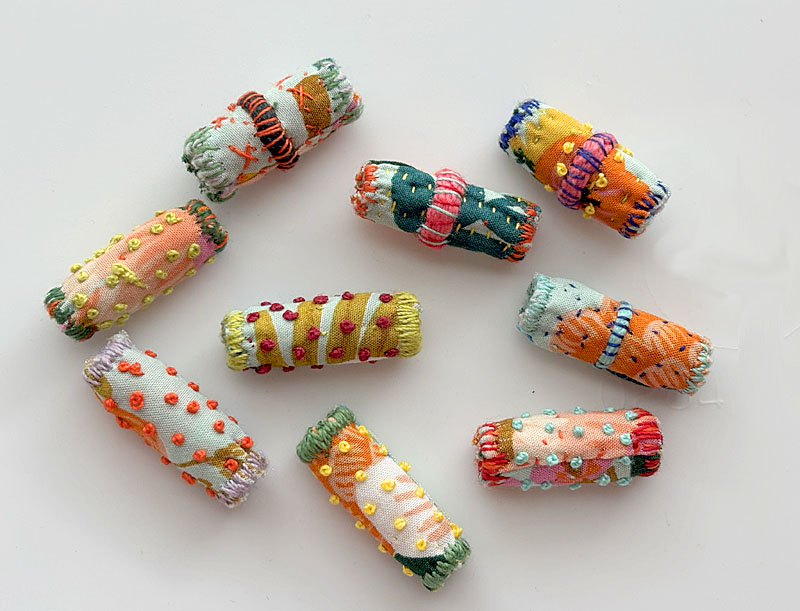
Some unfinished objects emerged from storage today. I made them during COVID, intending to do ??? with them. They are too pretty not to use. Those little bumps are not beads – they are French knots! Each bead is 3 cm long, or a little over an inch.
For a necklace, a luceted cord might be a good idea. Let’s see if the muscle memory of knotting the cords comes back after a long hiatus.. Once you get flying with one of these gizmos, you can crank out miles of cord.
Department of Books: I just finished reading Brazzaville Beach by William Boyd (highly recommended) and The Green Road by Anne Enright.
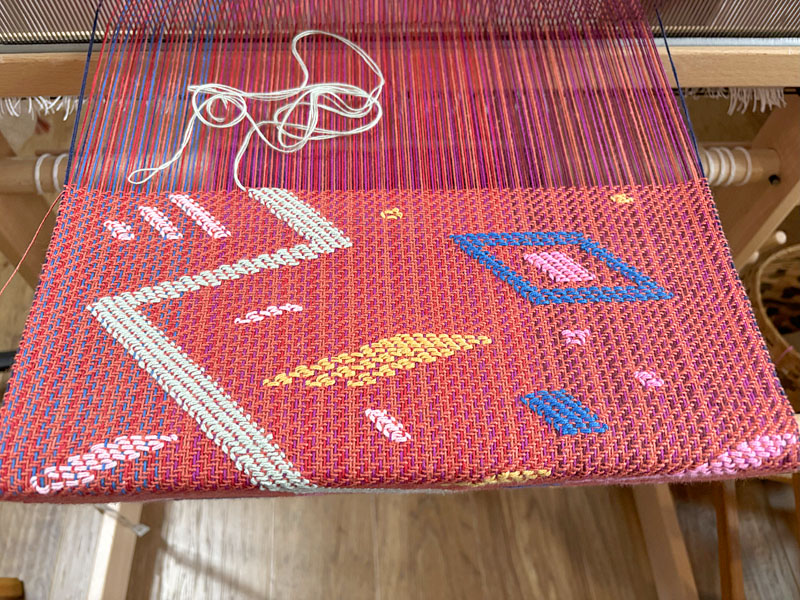
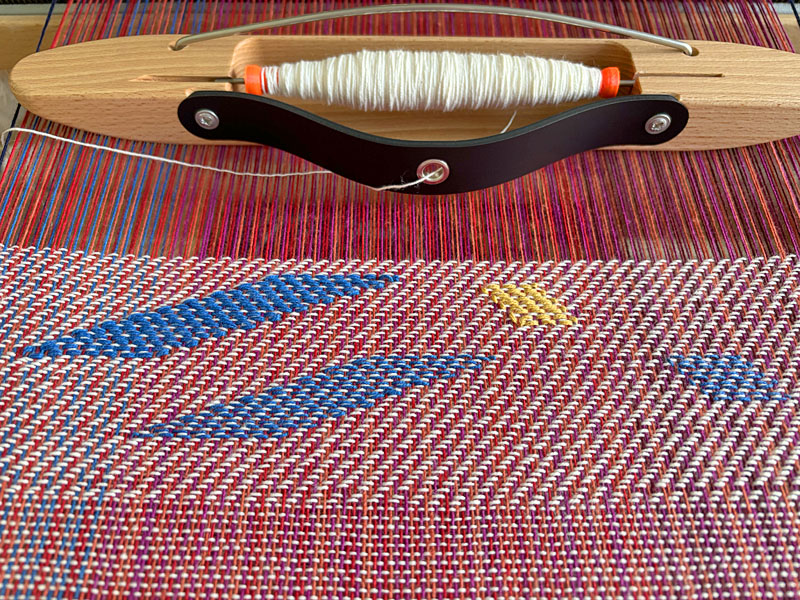
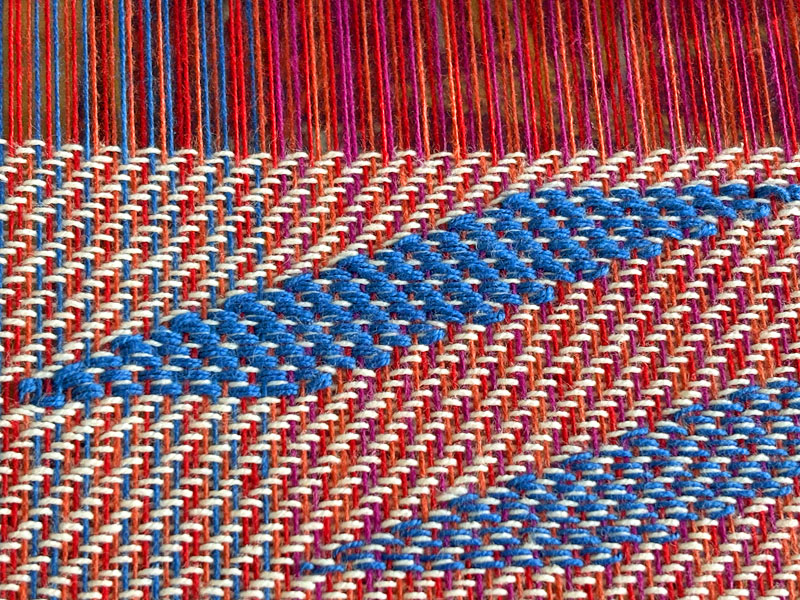
In my experiments with drafts for brocading, I wanted to explore new possibilities for combinations of ground and brocade. In the following picture, I have tried to force the twill lines to run in opposition to each other. In the lower blue lozenge, I used a single end of blue 8/2 cotton as the brocading weft on a ground of 8/2 cotton weft used singly. I felt there wasn’t enough contrast between brocade and ground, so I doubled the brocading weft in the upper lozenge.
I like that effect better, and the opposing twills are more evident here.
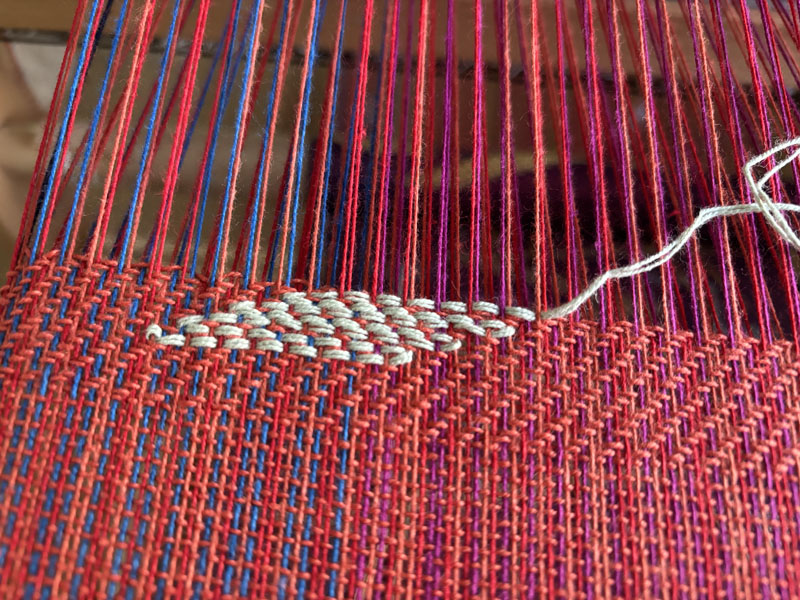
The next step was to improve the color choices. Although the natural ground weft in the above photo highlights the structure, I thought the color effect was too washed out; I redid the sample with an orange weft, which I think is more pleasing, even though structure takes a back seat here.
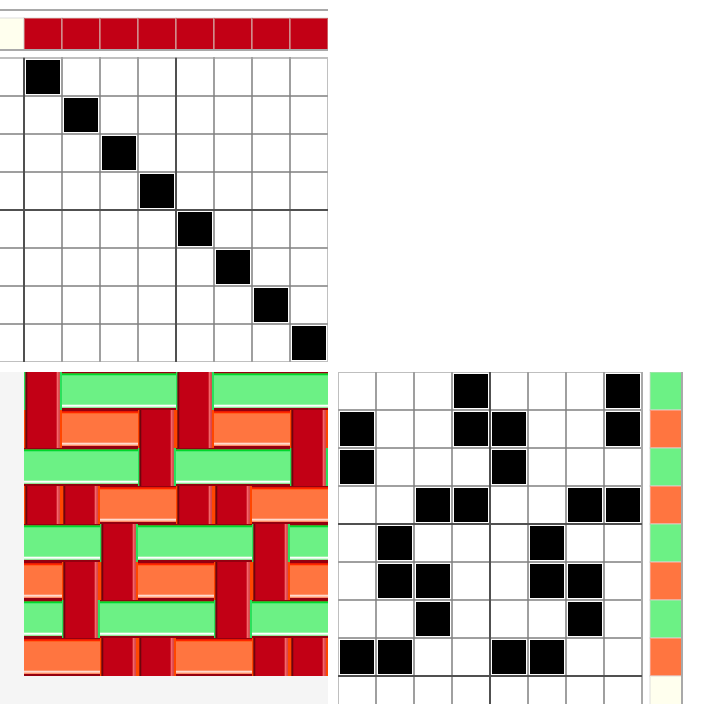
The brocading weft is two strands of 8/2 cotton. I am happy with the colors, and I think the opposing twill lines show up really well here. For the curious, here is a screen shot of the draft I am using.
Department of Books: I have just finished reading Brotherless Night by V. V. Ganeshanantan. Recommended.